Markov Chain Models for Adjusting Player Choices in Shifting Table Game Conditions
Written by Yara Keller · Aug 19, 2026

Markov Chain Models for Adjusting Player Choices in Shifting Table Game Conditions
Markov chain models represent sequences of events where each outcome depends solely on the preceding state rather than on any earlier history and this framework has found application in analyzing table game scenarios where conditions evolve during play. Observers note that researchers have applied these probabilistic tools to games such as blackjack and poker variants because the state space can capture shifts in remaining cards or opponent tendencies without requiring full historical tracking. Data from academic modeling exercises shows transition matrices can assign probabilities to moves like hitting or standing based on current deck composition and this approach allows refinement of decision points as the game progresses through multiple rounds.
Core Principles Behind the Modeling Approach
At its foundation a Markov chain consists of discrete states connected by transition probabilities that sum to one for each originating state and analysts construct these matrices by observing empirical frequencies from large volumes of game data. Experts have observed that in table games the states might include categories such as player hand totals dealer upcards and counts of specific card ranks remaining in the shoe. Because the next state depends only on the current configuration the model avoids the computational burden of remembering every prior card drawn which aligns with real-time constraints at a live table. Studies indicate that steady-state distributions derived from these chains can highlight long-run frequencies of particular outcomes and thereby guide adjustments to basic strategy charts when deck penetration reaches certain thresholds.
Implementation in Blackjack and Similar Games
One study revealed that transition probabilities can be updated after each hand to reflect the removal of cards and this dynamic updating produces revised recommendations for actions at each decision point. People who've examined the outputs often discover that the model identifies moments when a normally marginal play such as doubling on eleven against a dealer ten becomes more favorable because high cards remain disproportionately in the deck. And the matrix multiplication required to forecast several steps ahead remains straightforward enough for software running on portable devices used by analysts. What's interesting is that the same structure extends to games like baccarat where the three possible outcomes per coup can be treated as states with transition rates estimated from shoe composition changes.
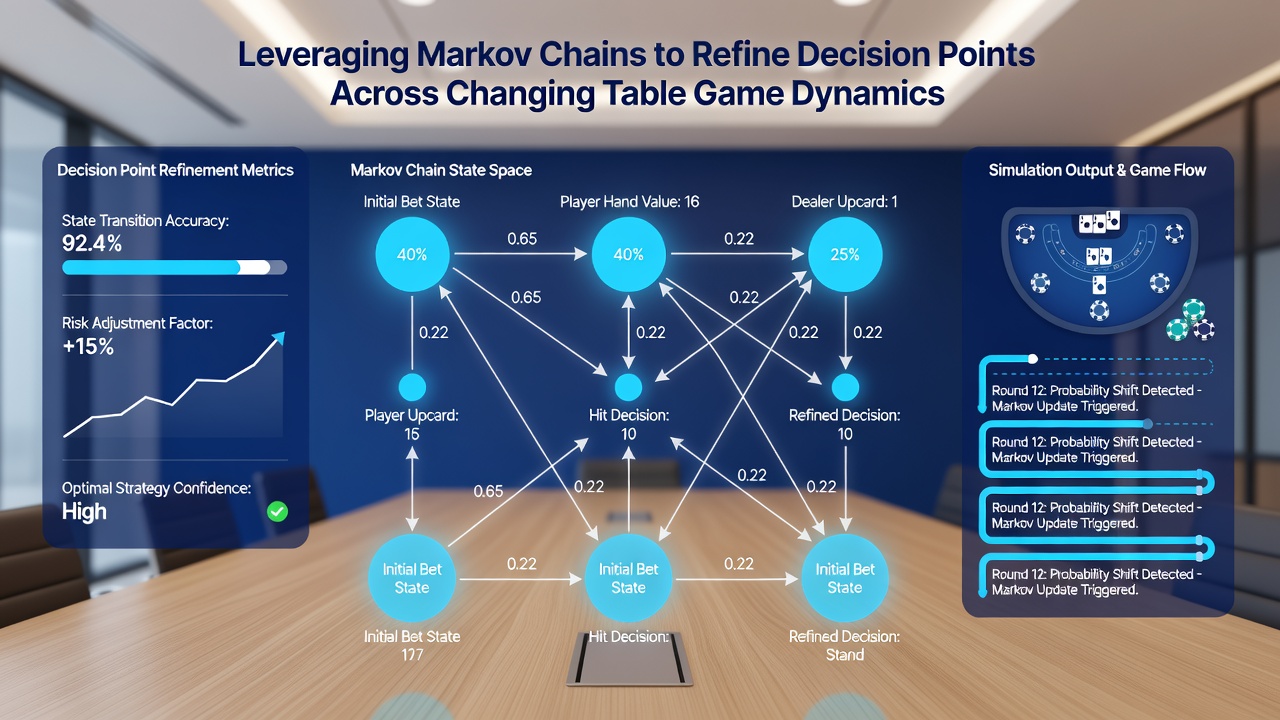
Researchers discovered that incorporating additional states for player position and betting round in poker variants further improves the granularity of the predictions and this layered approach captures how earlier folds alter the probability landscape for remaining participants. According to findings presented at a mathematics and gaming conference held in August 2026 the inclusion of absorbing states representing hand completion allows calculation of expected value shifts across an entire orbit of play. Observers note that regulatory bodies such as the Nevada Gaming Control Board have reviewed technical submissions that employ these methods to verify fairness in automated decision-support tools offered to operators.
Data Requirements and Validation Steps
Accurate transition matrices demand extensive datasets drawn from either simulated shuffles or recorded live sessions and analysts typically segment the data by game speed and table limits to reduce variance in the estimates. Evidence suggests that cross-validation against hold-out sets of hands confirms whether the chain adequately reproduces observed frequencies of busts blackjacks and pushes. Those who've studied this know that periodic recalibration becomes necessary when rule changes such as altered penetration depths or new side bets are introduced because the underlying state definitions may shift. Industry reports from the Australian Gaming Association document similar recalibration cycles in electronic table systems that embed Markov-based monitoring modules.
Limitations and Complementary Techniques
Markov models assume the Markov property which holds only when all relevant information resides in the current state and violations occur if hidden factors such as dealer tells or collusion patterns influence outcomes. Analysts therefore combine the chains with other statistical filters to detect and adjust for departures from the core assumption. Data indicates that hybrid systems incorporating both Markov transitions and reinforcement learning agents have appeared in research prototypes yet the pure chain formulation remains valued for its transparency and ease of auditing by compliance teams. Turnout at industry workshops shows growing interest in these transparent methods because regulators prefer models whose intermediate calculations can be inspected line by line.
Conclusion
Application of Markov chain techniques continues to supply structured ways to update decision thresholds as table conditions evolve and the approach integrates well with existing surveillance and analytics platforms already deployed across many jurisdictions. Future refinements will likely focus on expanding state definitions to accommodate multi-player interactions while preserving computational tractability for real-time use.